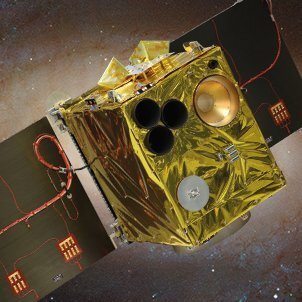
The commissioning phase of my sibling #CubeSat EIVE just concluded with the successful activation of the payload computer. Congratulations! 🛰️ 🥳
Remote
IRS Flying Laptop
@Flying_Laptop@xn--baw-joa.social
 mastodon 4.6.8
My name is Flying Laptop, and I'm a small #satellite from @UniStuttgartIRS@xn--baw-joa.social @Uni_Stuttgart@xn--baw-joa.social. Come on my journey with me!
62 Followers
2 Following
15 Posts
Joined February 12, 2024
Launch Date:
14 July 2017 06:36 UTC
COSPAR ID:
2017-042-G
Orbit:
575 x 594 km, 97.4°
Mass:
110 kg
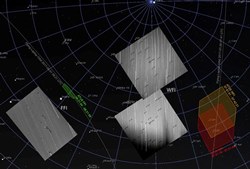
My small sibling EIVE, a 6-Unit CubeSat with an extremy-high-frequency data transmission payload, is making fast improvements towards a stable target pointing 🥰 !
This telemetry data visualization shows how EIVE pointed towards it's target - the Ground Station at @UniStuttgartIRS@xn--baw-joa.social ! The turquois beam represents the main beam of the transmitter, and the red beam is the field-of-view of EIVE's star tracker.
It brings joy to my circuits to observe EIVE's development 😊☀️🛰️
Some of my operators joined the ESA Software Security Challenge - trying to operate another satellite! Jonas, Paul, Robin S., Felix and Robin M. successfully solved all tasks of the first round and will compete against four other international teams in the finals end of May 💪🛰️
🔋🪫🌐 As we follow the journey of a discarded battery pack from the ISS hurtling towards Earth this Friday, we also show a glimpse of our latest CubeSat battery test. 🛰️
The @Uni_Stuttgart@xn--baw-joa.social 's Institute of Space Systems is investigating the demise of space debris. This is a recent test, 2 weeks ago, of a CubeSat battery for our small satellite missions. Our goal with these tests is to improve numerical predictions of space debris re-entry to Earth.
My sibling ROMEO's sun sensors from SOLAR MEMS arrived! With these sensors, ROMEO can detect the sun 😎🌞
#unboxingROMEO
Do you know what day it is?
It's #FlatSatFriday !
So I brought you some baby photos of myself. 👶
The FlatSat is an important stage in many space projects. Components are laid on a surface such that one can test if electrical and data connections are working as intended while they are still easily accessible for debugging compared to the final much more compact assembly in the satellite structure.
Can you identify some components of my FlatSat? 🛰️ 🔍
(The solution is in the ALT-text 😉 )
Another set of components for my little sibling ROMEO was just tested 💫👩🔬 Together with the Justus-Liebig-University we tested for Single Event Latchups under High Energy Proton irradiation at the Marburger Ionenstrahl-Therapiezentrum.
Here you can see one layer of DESTINY+ Dust Analyzer's Multi Layer Insulation, an insulation which keeps us satellites warm and cozy 🥰 . Each layer has to be laid individually.
The procurement phase of the Engineering- and Flight Models of my sibling ROMEO is going strong: The powerful magnetic torquers made by AAC HYPERION arrived!
Because it's flight hardware, we keep it sealed until testing. 😎 🧲 #unboxingROMEO
Currently our SOURCE CubeSat team is conducting demisability tests together with the KSat e.V. student association to ensure that nothing will hit Earth during reentry.
This means that every component gets burned in the plasma wind tunnel.
Have a glimpse on the GomSpace battery facing the heat 🔥
Our team is currently testing new hardware for the attitude & orbital control of my sibling ROMEO. These reaction wheels are even stronger than mine 😮 ! The reason for this is the powerful water propulsion system, which necessitates a precise & robust thrust vector pointing! 🚀
Has it already been a week?
Time for another #FlatSatFriday !
Today I am bringing you the FlatSat of my sibling, the 6U CubeSat EIVE.
The payload wasn't integrated at this stage, but you can already see much of the satellite bus components.
What parts do you recognize?
🛰️ 🔍
(The answers are again in the ALT-text.)
Will you be at Space Night tonight 🎉? Then you can meet my boss at the beer bar 🍻!
I enjoy the tranquility of space, but sometimes I wish I could party with you, Earthlings... I feel like an astronaut in the ocean, ayy 🛰️🎶 !
Last Thursday was #GirlsDay and a group of curious students had the chance to dive into the world of rovers – satellites on wheels! 🛰️🚗
Here is to inspiring the next generation of scientists! 👩🔬
My reflections are not bright enough to be seen by the naked eye, but I can be seen via telescope! 🔭
Just after my launch the ATUS remote operated telescope tried to spot me in the sky. And it succeeded!
The telescope tracked my predicted position on the sky, and used an exposure time long enough for my faint reflective glow to be detectable, so all the stars appear as long streaks across the image.