
#oilpainting
52 posts · Last used Sep 20

Boosted by @MaryAustinBooks@mstdn.social
By Flemish painter David Teniers the Younger (1610–1690), better known for his scenes of peasants and tavern life: Cat Concert (Katzenkonzert), oil on panel, 26 x 31.5 cm, Bavarian State Painting Collections, Staatsgalerie Neuburg. #art #arthistory #painting #oilpainting #cats
Katzenkonzert was a popular theme at the time. Sometimes called a “glaring of cats,” referring to a group of 3 or more cats.

"Blue Silence"
40 cm × 30 cm
Oil on canvas
#Oilpainting #Art #PixelfedArt #Mastoart #MastodonArt #Fediart
#Diving #Swimming #Underwater
Nude Man Lying on a Bed (1917), John Singer Sargent
#oiloncanvas #oilpainting
Sensitive
Been using the “daluren vrij” ticket to go to Amsterdam today. I went and painted for 10 hours straight, which is a bat ridiculous. But I got a relatively big painting done so that’s good. The place I chose to paint is the small Sint Annenstraat.
#Amsterdam #cityscape #landscapepainting #painting #oilpainting #allaprima #pleinair #kunst #art #mastoart #fediart
Today at the portrait I tried to make simpler statements and not go with transitions. Normally I go towards transitions and more details at some point but I tried to hold myself back, trying to optimize my shapes instead. It didn’t go very well yet I think. I will look at some masters that do those better and maybe make better decisions with the next one. I really want to learn this
#portraitpainting #painting #oilpainting #mastoart #fediart #allaprima
Sensitive
I have painted these Dahlias. It was a challenge to get all of these leaves and such on the panel but I think I managed in the end. During the whole process, there was a chicken constantly trying eat my yellow ochre.
#oilpainting #Flowerpainting #painting #pleinair #art #kunst #mastoart #fediart
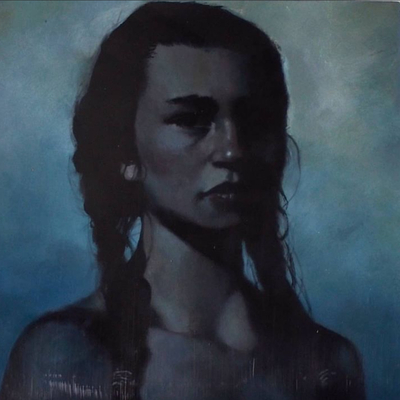
A work in progress. 75 x 75 cm, oil on mdf. The first layer of the painting evolves slowly, but I think the mood is already somewhat there.
#oilpainting #oilonmdf #artwip #workinProgress #mastoart #mastoartis #taide #öljymaalaus #maalaus #maalaustaide #kuvataide #fineart #contemporaryart #figurepainting
Did a outdoorsy portrait the other day, I am pleased with some of the colors, trying to evoke the light summer feeling of impressionist portraits. The sitter liked it too.
#portrait #portraitpainting #painting #oilpainting #impressionism #allaprima #art #kunst #MastoArt #fediart
Here is the final #oilpainting The subject is based of a photograph from 1910, made in #Lofoten (Norway). The man in the portrait unfortunately isn't named, but he was a #cod #fisherman working in the dried codfish export. The photograph has always struck me, seeing these everyday people dragging these strange creatures out of the depths they never got to see with their own eyes. The painting is made with water-mixable oils.
#lofotfiske
Vincent van Gogh (1853–1890), The Prison Courtyard (after Gustave Doré), 1890, oil on canvas, 31.4x25.1 inches (80x64 cm), Pushkin Museum of Fine Arts. #arthistory #painting #oilpainting #vangogh #prison
From HSE University, Moscow: “Vincent van Gogh painted The Prison Courtyard in 1890, inspired by an engraving by French illustrator Gustave Doré. In February 1890, Van Gogh was staying at the Saint-Paul-de-Mausole asylum, where he had no opportunity to paint from life…
When examining Van Gogh's painting, one can notice a pair of butterflies fluttering against the prison wall. For the artist, they may have symbolized hope for liberation…
When painting this work, Van Gogh primarily used blue paint. The artist was known for his fondness for cool blue, which he combined with warm yellow to convey his inner state. The clash of these two colors also symbolizes the inner conflict that marked Van Gogh’s life—between hope and despair, joy and sorrow. The artist often used blue for his self-portraits. Through blue and its many shades, he sought to understand himself as a person and as an individual.”
Painting the portrait at Dekaai again. It was raining pretty badly which is fine for the painting. But I didn’t bring any raincoat or even a jacket or something so it was quite cold. Either way, the model chose my painting again which today was fine since I didn’t really want to carry it home through the rain.
#Oilpainting #painting #portraitpainting #kunst #art #mastoart #fediart
Your art history post for today: by Thomas Cole (1801-1848), “The Course of Empire: Destruction,” 1836, oil on canvas, 39 1/4 × 63 1/2 inches (99.7 × 161.3 cm), collection of The New York Historical. #arthistory #painting #oilpainting
From the museum: ‘On August 30, 1836 the artist wrote to his friend and fellow artist Asher B. Durand "I have been engaged in Sacking & Burning a city ever since I saw you & am well nigh tired of such horrid work." The vainglorious city that Cole depicted in The Consummation of Empire has fallen to a savage enemy, and the critic for the New-York Mirror lauded Cole's critique of imperial rule, agreeing with the artist's depiction that "[s]uch is the merited downfall of all the empires which the earth has heretofore known." Instead of the statue of Minerva, goddess of wisdom, that kept watch over The Consummation of Empire, a headless colossal figure taken from the Louvre's Borghese Warrior witnesses the rapacious acts of the invading army. Cole was likely influenced by the English painter John Martin's panoramic scenes of apocalyptic disaster, and he no doubt knew that his depiction would bring to mind the terror and destruction wrought in New York by the Great Fire of 1835. Unlike the other paintings, here Cole's signature is audaciously large and carved in slashing letters, almost like an act of vandalism, on the pedestal of the ruined statue at the right.’
Trying my luck with sunlit trees again. I am happy with the sporadic markings. Though most of the time was spend deleting details that were distracting/disruptive. It’s still a daunting and impossible subject to paint. I think I should have painted a tree more up close. It’s an improvement though.
#landscapepainting #painting #oilpainting #allaprima #pleinair #art #kunst #wodanseiken #mastoart #fediart
Another work in progress, first layer of a painting, oil on mdf. I’m happy with how this is turning out!
#oilpainting #artsketch #artwip #öljymaalaus #taide #kuvataide #art #mastoart #firstlayer
I tried to see if I could tackle this extremely difficult subject. Used a lot of (for me) new techniques, tried out different ways to handle knife and brush to get the marks to create the sort of noise I required. Don’t know if I am happy with the result but I did make a painting I guess.
#landscapepainting #meadow #oilpainting #pleinair #painting #art #kunst #mastoart #fediart #allaprima

Replying to